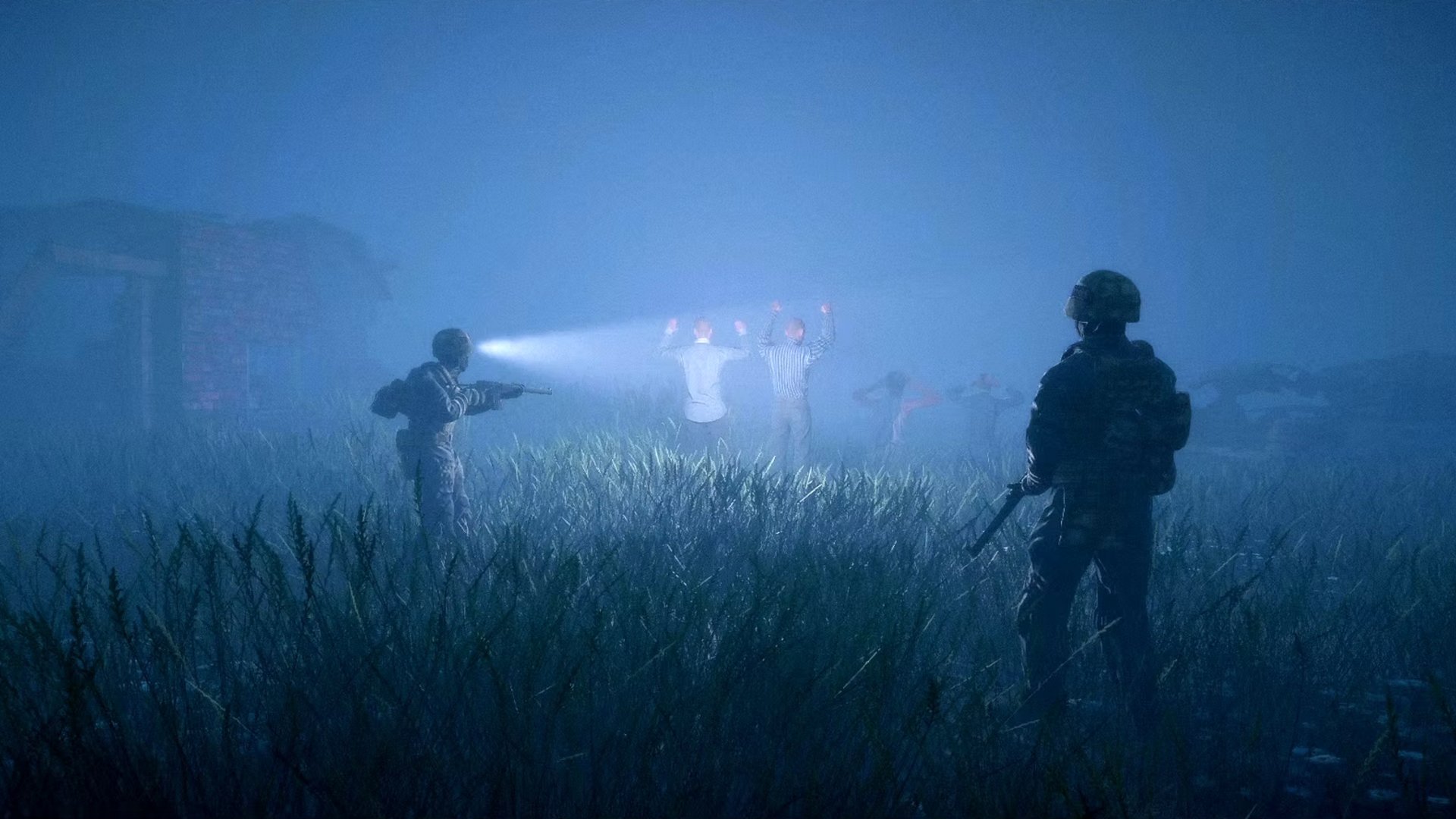
© still Scent
© still Scent
Doxumentale understands non-fiction storytelling as a broad field that reaches far beyond the classical documentary film and negotiates reality across a wide range of media. Within this spectrum, video games occupy a peculiar position. Often passing under the radar of established film festivals, they have long offered works that engage critically and artistically with social and political subjects.
Technological developments in recent years have shifted this field once again: what used to be the privilege of large studios is now within reach of solo developers and small teams. They produce works of high formal and production quality, in which cinematic narration and interactive experience intertwine.
Scent by Alan Kwan is one such work. Developed largely on his own over the course of eight years, the game places its players in the perspective of a dog wandering through a nameless, war-torn landscape while gathering the souls of the fallen. No mission, no weapons, no clearly named conflict—only observing, hiding, moving on.
Raised in Hong Kong and now teaching at the School of the Art Institute of Chicago, the artist, filmmaker, and game designer deliberately positions Scent at the intersection of cinema and video games. In conversation, he speaks about the development process, how witnessing became the core mechanic of the game, and the potential of these kinds of experiences.
You began working on Scent in 2017, largely on your own. Over eight years of development, it became a game about war and witnessing. What kind of transformation took place within this time span?
In Scent, players embody a dog wandering through a war-torn city and gathering the souls of the dead. Over the years of development, I explored various ways for the player to interact with this virtual world. Ultimately, I realized that the most profound interaction was not action, but the act of witnessing – Witnessing war.
Also, in many games, "gathering" is a mechanism for progress or power. However, in Scent, these souls that you gather offer no utility. They don’t help you gain more power or achieve a goal. Instead, you are simply with these souls, journeying together through a landscape of suffering.
Scent intentionally names no specific war, yet it emerged during a period of extreme global conflicts. How did you arrive at this decision, and where do you see the line between openness that lets players bring in their own world, and abstraction that risks dissolving real suffering into the universal?
I am interested in observing human brutality through the perspective of an animal. In Scent, the location and identities of the people remain unknown. The player is not provided with the context of where or why this war is happening. Instead, war is experienced as a series of overwhelming sensory events. This approach forces the player to sit with the physical horror of the moment and the visceral reality of suffering. For me, the abstraction in this work is a tool to bypass intellectual understanding and invite a visceral emotional experience.
There is a long tradition of films, novels, and photojournalism about war. Video games, on the other hand, are almost allergic to talking about the meaning of war. Why did it nevertheless need to be a game to convey what Scent wants to tell?
In many video games, players are granted superpowers, which are obviously something they don’t have in the real world. They are empowered. In Scent, I wanted to do the opposite: leverage the interactive nature of the medium to make players feel powerless. They are given a controller, but are simultaneously forced into a state of witnessing without any power.
At the same time, you hesitate to call Scent a "game" and have suggested that we might need new terminology for interactive virtual works that aren't really games. What does that mean for an audience encountering Scent in an exhibition context? And where do you see the medium going from here?
I view Scent as an interactive experience situated at the intersection of cinema and video games. It’s short, immersive, and emotionally complex. The controls are simple, removing the barrier for those unfamiliar with traditional gaming. I believe in the potential of these concise, interactive cinematic works—experiences that prioritize artistic depth and production quality over the traditional demands of long-form gameplay.
Scent offers no answers, only observation. Yet the game emerges in a moment when many people feel paralyzed by the daily proximity of war, scrolling through images they often cannot process. What do you wish a player carries with them from Scent after they have engaged with it?
I hope that after experiencing Scent, the player is left with a deep, lingering sensation. Perhaps a complicated mixture of loss, grief, and a sense of hope. My goal is for the work to speak directly to their souls, even if only for a few seconds.
![[Translate to German:]](/fileadmin/_processed_/b/9/csm_A_fox_under_a_pink_moon-_4a145cf3a4.jpg "[Translate to German:]")